
 By
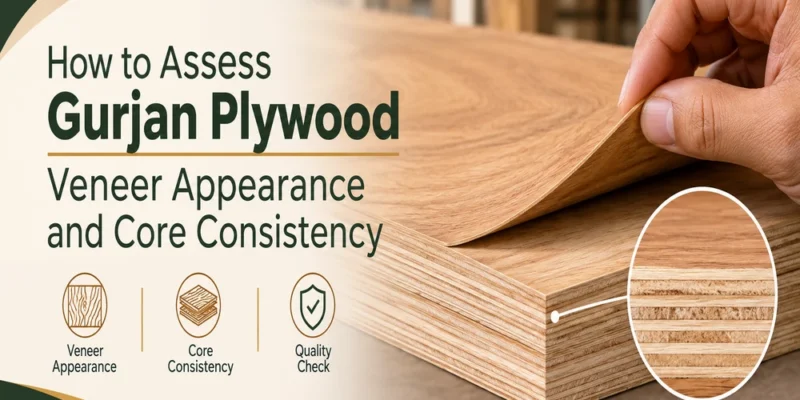
Selecting plywood for your furniture or interior projects necessitates taking into account many things, not only the look of the outer layer of the sheet of plywood. The appearance of the veneer and the stability of the core can give us important signs regarding the quality of manufacturing, reliability of the plywood structure, as well as its functionality. Knowing those characteristics ensures better evaluation of plywood by purchasers before making a decision about buying plywood.
Examine the Face Veneer for Appearance and Quality
The face veneer seen on plywood is the outermost layer contributing to the final appearance of furniture, cabinets,s and decorative panels. For the purpose of evaluating Gurjan plywood, one should look at its surface to detect whether it looks uniform and whether there are any defects or patches present. Uniformity of appearance is a good indicator facilitating the finishing process, especially when the surface is intended to be covered with varnish or other decorative coverings.
There might be natural differences in grain and colour, so the presence of small defects does not always indicate poor quality. However, if there is enough defectiveness, the issue requires more attention. While inspecting Gurjan plywood sheets, check the corners and edges for veneer detachment or delamination. You cannot rely only on surface inspection when assessing bonding strength; thus, it is essential to review the product specifications and quality documentation.
Assess Core Consistency Through the Sheet Edges
The core is made of all internal veneer layers that make plywood durable. Checking the edges provides an opportunity to spot any gaps and voids, or badly aligned layers and veneers. A good core should contain layers that fit perfectly without any clear gaps.
When inspecting premium Gurjan plywood, make sure to find layers that are arranged uniformly and have substantially uniform thickness. Big voids can decrease stability and strength where the fasteners are located, affecting subsequent loads. Unfortunately, an edge inspection does not provide sufficient information about the entire interior of plywood sheets.
Look for Gaps, Voids, and Uneven Layers
The only reason gaps and voids can appear in ply is because of poorly prepared, arranged, and bonded core veneers. Defects that can be hard to spot on the whole sheet will become obvious in a section cut from it. When choosing Gurjan plywood sheets for furniture, it is essential to take a close look at the edges to look for gaps, as well as the veneer to check for evenness before making any cuts. It is very important to look closely at the sheets that will be used for cabinets, shelving,g and other parts of the furniture that need reliable support from nails, screws, or fittings. The visual inspection must be supplemented with information on the manufacturer’s quality assurance processes and product specifications.
Evaluate Thickness, Flatness and Overall Construction
The plywood panel must be sufficiently flat and regular in thickness for the intended application. Any warping, uneven edges,s and noticeable variation in thickness will make it difficult to cut, join, and install the plywood. This will also affect the alignment of the cabinet panels as well as the overall quality of the furniture that will be produced.
When possible, it is best to measure the panel to check how close it is to the declared thickness. Check for bending or twisting by placing the panel on a flat surface. Checking flatness and thickness is especially useful when working with several sheets of plywood being used together for one piece of furniture.
Verify Product Specifications and Quality Documentation
Visual inspection is useful, but it cannot independently determine the type of each layer of veneer, the quality of the adhesive used, the moisture resistance of the product, or whether it corresponds to any given standard. The buyer has to check the manufacturer’s specifications and ask for relevant test reports or certification documents, if necessary for a given project.
Royale Touche plywood products can be checked in accordance with their declared specifications, the intended application, and the available quality documentation. A buyer should avoid making conclusions only based on the surface appearance of Gurjan plywood sheets, as their performance depends not only on the appearance of the sheets, but also on the quality of the core construction and how uniformly the product was manufactured.
Conclusion
Checking the veneer looks and the core consistency requires assessing the visible surface of the plywood panels, inspecting the edges, checking for gaps, and measuring the thickness and flatness of the plywood panels. These simple procedures will help avoid obvious problems with the plywood sheets before buying or using them.
For furniture making and other interior projects, using a combination of visual inspection of plywood and the relevant specifications for the product gives a better basis for selecting the right product.









Comments