
 By
Reinforced concrete has a reputation for lasting indefinitely, and building owners often take cracks and rust stains on an older structure to be cosmetic. They are usually the visible end of a chemical process that has been advancing inside the concrete for years. Concrete Repair for ageing RC structures is the work of halting that process and restoring the section before strength is lost. Knowing how deterioration develops helps owners judge when to act and what a proper repair should include.
How Reinforced Concrete Protects Its Steel
Concrete is strong in compression and weak in tension, so steel bars are cast within it to carry tensile forces. Fresh concrete is highly alkaline, and in that environment a thin, stable oxide film forms on the steel and prevents rusting. The layer of concrete between the bar and the surface, known as the cover, shields the steel from air and moisture. As long as the alkalinity and the cover remain intact, the reinforcement is protected.
Carbonation: The Slow Loss of Protection
Carbon dioxide in the air gradually reacts with the alkaline compounds in concrete, working inwards from the surface over decades. This carbonation lowers the alkalinity. When the carbonated zone reaches the depth of the reinforcement, the protective film on the steel breaks down. With moisture and oxygen present, corrosion begins. Warm, humid conditions and thin or porous cover speed the process, which is why it is so widespread in older buildings in the tropics.
From Rust to Spalling
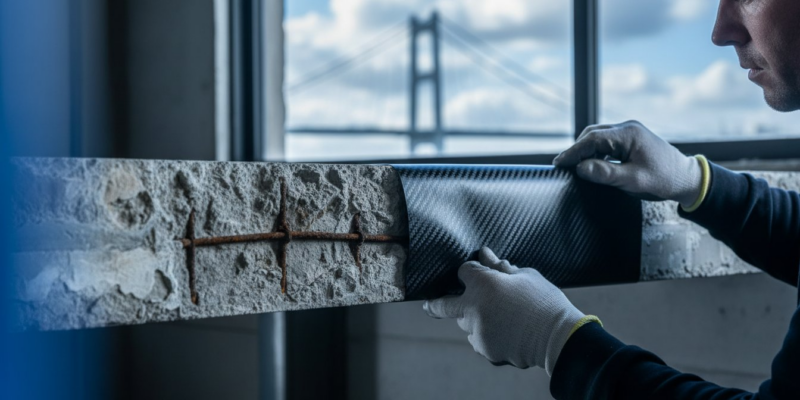
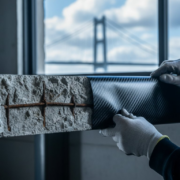
Rust occupies several times the volume of the steel from which it forms. As a bar corrodes, the expanding rust exerts pressure on the surrounding concrete, producing cracks along the line of the reinforcement. The cover then separates and eventually falls away, exposing the steel. Repair work most often begins at this stage, when pieces have dropped from a ceiling or beam, although the corrosion behind them started long before anything was visible.
Signs That an Ageing Structure Needs Attention
Typical indications include cracks running parallel to the reinforcement, brown rust staining, bulging or hollow-sounding areas of plaster and concrete, and exposed bars. These appear most frequently on ceilings beneath wet areas, on balcony edges, external beams and columns, and in car parks. Any fallen fragment should be treated seriously, both as a hazard to people below and as evidence that the steel in that location has been corroding for some time.
Investigation Before Repair
Concrete Repair for ageing RC structures starts with understanding the extent and cause of the damage. A survey maps visible defects and uses hammer tapping to locate delaminated areas that have not yet fallen. A cover meter measures the depth of concrete over the bars. Carbonation depth is checked by applying an indicator solution to freshly exposed concrete, and samples may be tested for chloride. Where steel has lost significant section, a structural engineer should assess whether strengthening is needed.
The Patch Repair Sequence
Defective concrete is broken out until sound material and clean steel are reached, continuing behind the bars and along them beyond the corroded length. Rust is removed from the steel, and bars that have lost too much section are supplemented. The steel is then coated with a protective primer, a bonding agent is applied and the section is rebuilt in layers with a polymer-modified repair mortar. Proper curing completes the repair. Each step has a purpose, and omitting any shortens the life of the work.
Why Plastering Over Fails
The cheapest response to spalling is to knock off the loose pieces and replaster. This traps active corrosion beneath a new surface. The steel continues to rust, the fresh plaster cracks within a year or two and the defect returns larger than before. A repair that does not expose the steel fully, clean it and restore alkaline protection around it has addressed appearance only. The difference in initial cost is quickly overtaken by the cost of repeating the work.
Treating Cracks and Protecting the Surface
Cracks that do not involve corrosion may be sealed by resin injection, restoring continuity and keeping water out. After patch repairs, an anti-carbonation coating applied to the wider surface slows further ingress of carbon dioxide and moisture into concrete that has not yet deteriorated. Just as important is removing the source of water. Unless the leaking roof, bathroom or facade above is waterproofed, the conditions that caused the damage remain in place.
Inspection Obligations and Timing
Buildings in Singapore are subject to periodic structural inspection by a professional engineer, every ten years for residential buildings and every five years for most others. Owners need not wait for that cycle. Deterioration accelerates once the cover has cracked, because water and air then reach the steel freely. A defect repaired when it is the size of a dinner plate costs a fraction of the same defect left for five more years.
Deciding How to Proceed
Owners and managing agents should arrange a survey when the first signs appear, obtain a scope that states how far concrete will be removed and which materials will be used, and involve an engineer where structural members are affected. Fix the source of moisture at the same time. Concrete Repair for ageing RC structures is most economical and most durable when it is undertaken early, specified properly and paired with waterproofing, and not postponed until fragments begin to fall.





Comments