
 By
By 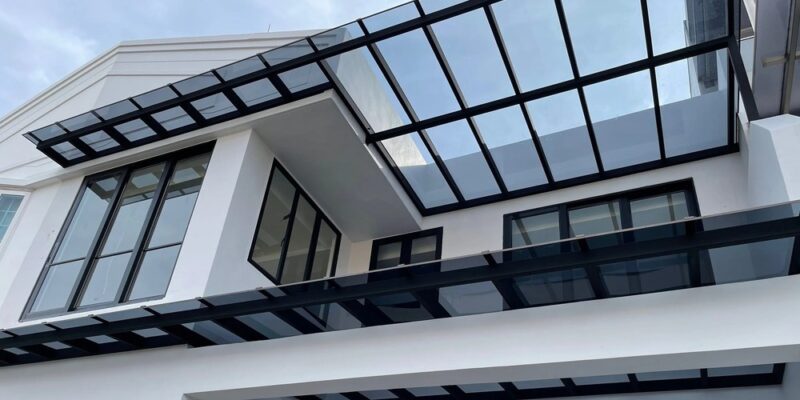
Polycarbonate awning Singapore installations are the most widely used form of overhead shelter for residential terraces, HDB void deck areas, commercial walkways and carports across the island. The material has specific properties that make it well suited to Singapore’s climate, and understanding what those properties are helps homeowners and building managers make informed decisions rather than simply accepting whatever the contractor recommends.
Why Polycarbonate Works in Singapore’s Climate
Polycarbonate is a thermoplastic polymer with several physical properties that matter in a hot, humid, rain-intensive environment. Its impact resistance is approximately 200 times greater than standard glass of the same thickness, which means it handles hail, falling branches and debris without shattering. This durability is significant in Singapore, where afternoon thunderstorms regularly bring both heavy rain and gusts that carry material.
Light transmission is the second key property. Clear or tinted polycarbonate panels transmit visible light, creating a bright space below rather than a dark enclosed one. The light quality under a polycarbonate awning differs from an open sky but is substantially better than the near-darkness under an opaque metal cover.
UV stabilisation is the property most critical to long-term performance in Singapore. Uncoated or poorly stabilised polycarbonate yellows and becomes brittle under sustained UV exposure. Quality panels are co-extruded with a UV-protective layer on the exposed surface that blocks the UV wavelengths most responsible for material degradation while allowing visible light to pass through. This UV layer is the component that determines how long the panel retains its appearance and structural integrity in Singapore’s sun intensity.
Polycarbonate Panel Types
Polycarbonate awning Singapore installations use panels in several configurations, each with different performance characteristics.
Twin-wall polycarbonate consists of two parallel surfaces separated by internal longitudinal ribs. The air gap between the surfaces provides thermal insulation, reducing heat transmission through the panel compared to solid sheet. This is the most common configuration for residential awnings in Singapore.
Multiwall panels have three or more internal layers and provide greater thermal insulation than twin-wall. They are thicker and heavier but reduce the heat gain in the space below more effectively. For enclosed or semi-enclosed spaces where heat accumulation is a concern, multiwall panels are the appropriate choice.
Solid polycarbonate sheet, sometimes used for sections that need to be bent to shape, provides less thermal insulation but can achieve tighter curves in the awning design. It is used where the structural or aesthetic requirements call for it rather than as the default choice.
Comparing Polycarbonate with Glass
Glass provides better optical clarity and a more premium appearance than polycarbonate, and it does not yellow or scratch in the way that polycarbonate can over time. For high-end residential and commercial applications where appearance is a priority, glass roofing panels are a serious alternative.
The practical differences in favour of polycarbonate for most Singapore applications are weight and impact resistance. Polycarbonate is substantially lighter than glass of equivalent area, which reduces the structural load at the attachment points and allows lighter frame sections. Its impact resistance reduces the risk of breakage from storm debris. For properties where the glass overhead could pose a safety risk if broken, polycarbonate provides meaningful reassurance.
“Materials chosen for function as well as appearance are the foundation of structures that age well.” – Goh Chok Tong, former Prime Minister of Singapore.
Installation Considerations
Polycarbonate panels expand and contract with temperature changes. In Singapore, where roof surface temperatures can vary by twenty or more degrees Celsius between a cool morning and a sun-exposed afternoon, this thermal movement is not negligible. Panels must be fixed with proper expansion allowance at the joints and fasteners. A contractor who screws through the panel without expansion allowance creates a system that will crack or buckle within a few years as the panels move against fixed restraints.
Drainage design is equally important. Water that pools on a polycarbonate awning creates algae and sediment stains that are difficult to remove and detract from the panel’s appearance. A slope of at least 5%, and ideally 10%, ensures rain runs off efficiently. Downpipes positioned at the low edge of the awning carry the runoff away from the building and any occupied areas below.
Cleaning the panels at regular intervals, typically twice a year, with a mild detergent and soft cloth removes atmospheric dust and pollution deposits that dull the surface. Avoid abrasive cleaners or materials that scratch the UV coating, as scratches accelerate UV degradation at the damaged points.
Choosing Quality Materials
The grading of polycarbonate panels is not always obvious from visual inspection. The UV protection layer quality, the panel thickness, and the chemical composition all affect performance but cannot be evaluated by looking at the panel in a showroom.
Request the manufacturer’s technical specification sheet from your contractor, and verify that the UV protection warranty for the specific grade of panel being installed covers the number of years you expect the awning to perform. Quality panels from established manufacturers carry UV performance warranties of ten years or more. Generic panels with no manufacturer warranty offer no basis for evaluating how long they will perform before yellowing or becoming brittle.
A polycarbonate awning Singapore installation done with properly specified panels, correct installation technique and adequate slope will provide reliable, attractive overhead protection for ten to fifteen years before any panel replacement is likely to be needed.

Comments