
 By
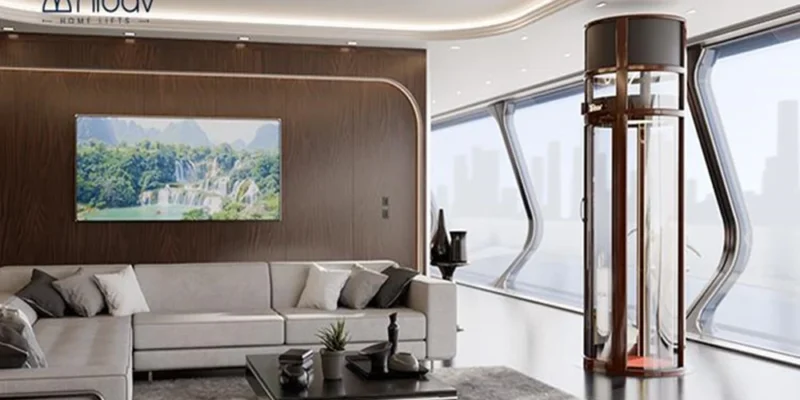
Introduction: When “How much can it carry?” becomes a safety question
A home elevator is meant to make everyday movement easier. Families step into it carrying groceries, school bags, parcels, mobility aids or other items. Guests may use it. Children may want to ride together. During busy moments, it is easy to overlook one basic question: is the total load within the lift’s safe operating limit?
That is where overload protection matters. Without a system that monitors load, a user may unintentionally ask the elevator to carry more than its rated capacity. For a residential product, the solution should be automatic rather than dependent on every family member remembering a number.
A smart overload alert for home elevators provides an additional safety layer. Nibav describes Smart Overload Alert as a system that detects when the recommended weight limit is exceeded, alerts the user and prevents the lift from operating until the load is reduced.
What is a smart overload alert?
A smart overload alert is an automated protection feature that monitors the weight inside the cabin against the elevator’s rated capacity.
If the load exceeds the safe limit, the lift does not simply continue moving. Instead, the system alerts the user and prevents operation until the excess load is removed.
That is different from relying on a printed capacity label alone. A label tells the homeowner what the maximum is. An overload protection system actively checks the operating condition.
For families, this is especially useful because everyday elevator use is unpredictable. A person may step inside carrying shopping bags. Another family member may join. A child may enter at the last moment. A wheelchair or mobility aid may add to the total load.
Smart safety systems help turn a specification into an active protection mechanism.
Why overload protection matters in a family home
Home elevators are used by people with different ages, heights and habits. Commercial elevators are often managed by building rules and visible capacity signage, but a private home does not have the same level of supervision.
A family-oriented lift should therefore be designed around normal household behaviour.
A smart overload alert can help in several situations:
· A family enters the cabin together
· Someone carries heavy groceries or luggage
· A wheelchair or mobility aid is brought into the cabin
· Children attempt to use the lift together
· Guests are unfamiliar with the cabin’s capacity
· Household items are moved between floors
The feature is not a substitute for following the manufacturer’s rated capacity. Instead, it adds an automated check that helps prevent the lift from operating outside its designed parameters.
For Malaysian homeowners, this can be especially relevant in multigenerational homes. Research and home-modification initiatives in Malaysia increasingly emphasize safer, more accessible environments that allow older people to remain independent at home.
Who should pay particular attention to home elevator safety systems?
Families with children benefit from layered safety because children may not always understand load limits or operating rules.
Multigenerational households may have several users with different mobility needs. Older adults, caregivers and children can all use the same lift.
Wheelchair users and caregivers need capacity to be considered alongside cabin dimensions and doorway access. A larger model may be more appropriate when assisted access is required.
Frequent users should consider how safety systems perform during everyday operation rather than looking only at appearance.
Homeowners comparing residential elevators in Malaysia should ask about overload protection, door interlocks, emergency descent, emergency communication and power-outage provisions before choosing a model.
Nibav and the smart overload alert for home elevators in Malaysia
Nibav places Smart Overload Alert across its home elevator range. The feature is described as an automatic system that prevents the lift from moving when the load exceeds the maximum safe capacity.
The Malaysia product range also includes other safety features. Depending on the series, these include emergency descent, rapid rescue provisions, child switches, door detection or locking systems, backup lighting and ventilation, emergency communication and braking systems.
For example, the Series III Standard has a 210 kg capacity and includes emergency descent, precision landing levers, rapid rescue latch, triple-door safety, child-lock switch, overload and obstruction sensors, emergency stop and backup lighting and ventilation.
The Series V and Series V Max add further features aimed at premium residential use, including SmartConnect emergency communication, Battery 2.0, a 30-minute auxiliary power provision, Smart Overload Alert, child switch and other safety mechanisms.
| Nibav safety feature | Family benefit |
| Smart Overload Alert | Prevents operation when the rated load is exceeded |
| Triple-layer door safety | Helps ensure movement is inhibited unless doors are secured |
| Emergency Descent | Supports controlled movement to a landing during power loss or failure |
| Child Switch | Helps restrict unauthorized use by young passengers |
| Rapid Rescue Latch | Provides a manual rescue provision for emergencies |
| Backup lighting / ventilation | Maintains essential cabin functions during outages on applicable models |
Choosing safe home elevators for families in Malaysia
A safe elevator is not defined by one feature. Homeowners should evaluate the entire safety architecture.
Start with capacity. Nibav’s Series III Standard and Series IV Standard are rated at 210 kg, while larger Max models are rated at 240 kg. Series V and V Max specifications similarly distinguish between standard and Max capacity. A larger cabin can be important for wheelchair users, caregivers or households with frequent multi-person travel.
Next, check door safety. The lift should prevent movement when doors are not properly secured. Nibav’s Malaysia materials describe triple-layer door-lock safety across relevant models.
Power loss is another important consideration. Ask what happens if electricity is interrupted. Nibav models include emergency descent and backup systems, with Series V documentation describing Battery 2.0 and auxiliary power provisions.
Finally, consider installation and service. A safety system is most useful when the lift is correctly installed and maintained according to the manufacturer’s requirements.
Frequently Asked Questions
1. What happens when a Nibav home lift is overloaded?
The Smart Overload Alert detects the excess load, alerts the user and prevents the lift from operating until the load is reduced to a safe level.
2. Do all Nibav home elevators have Smart Overload Alert?
Nibav states that Smart Overload Alert is included across its home elevator range, including Series III, Series IV and Series V models.
3. Is overload protection enough to make a home elevator safe?
No single feature is enough. A properly designed home elevator should combine overload protection with door safety, emergency descent, emergency communication and other applicable safety systems.
4. What capacity should a family home elevator have?
It depends on the number of users and accessibility needs. Families should consider not just passenger count but also mobility aids, caregivers and the physical size of the cabin.
5. Are Nibav home elevators suitable for families with elderly members?
Nibav positions its home lifts for elderly users and multigenerational homes. Model selection should consider cabin size, doorway width, capacity and the user’s specific mobility needs.
A well-designed home lift should make safe behaviour easy. The more a system can monitor automatically, the less the family has to rely on memory during busy everyday situations. That is one reason smart safety features are becoming an important part of the conversation around residential lifts.
When comparing a home elevator in Kuala Lumpur, Selangor, Johor or elsewhere in Malaysia, ask for a clear explanation of every safety feature and how it behaves in real situations. A good supplier should be able to explain capacity, overload protection, door safety, emergency descent, backup power and emergency communication before you make a purchase.
Smart technology is most valuable when it quietly supports the people using it. For a family home, that means turning safety from a list of specifications into something that works automatically during every ride.
In other words, smart overload protection is valuable precisely because it does not require the user to think about it every second. It works in the background and intervenes when the load condition is outside the safe range.






Comments